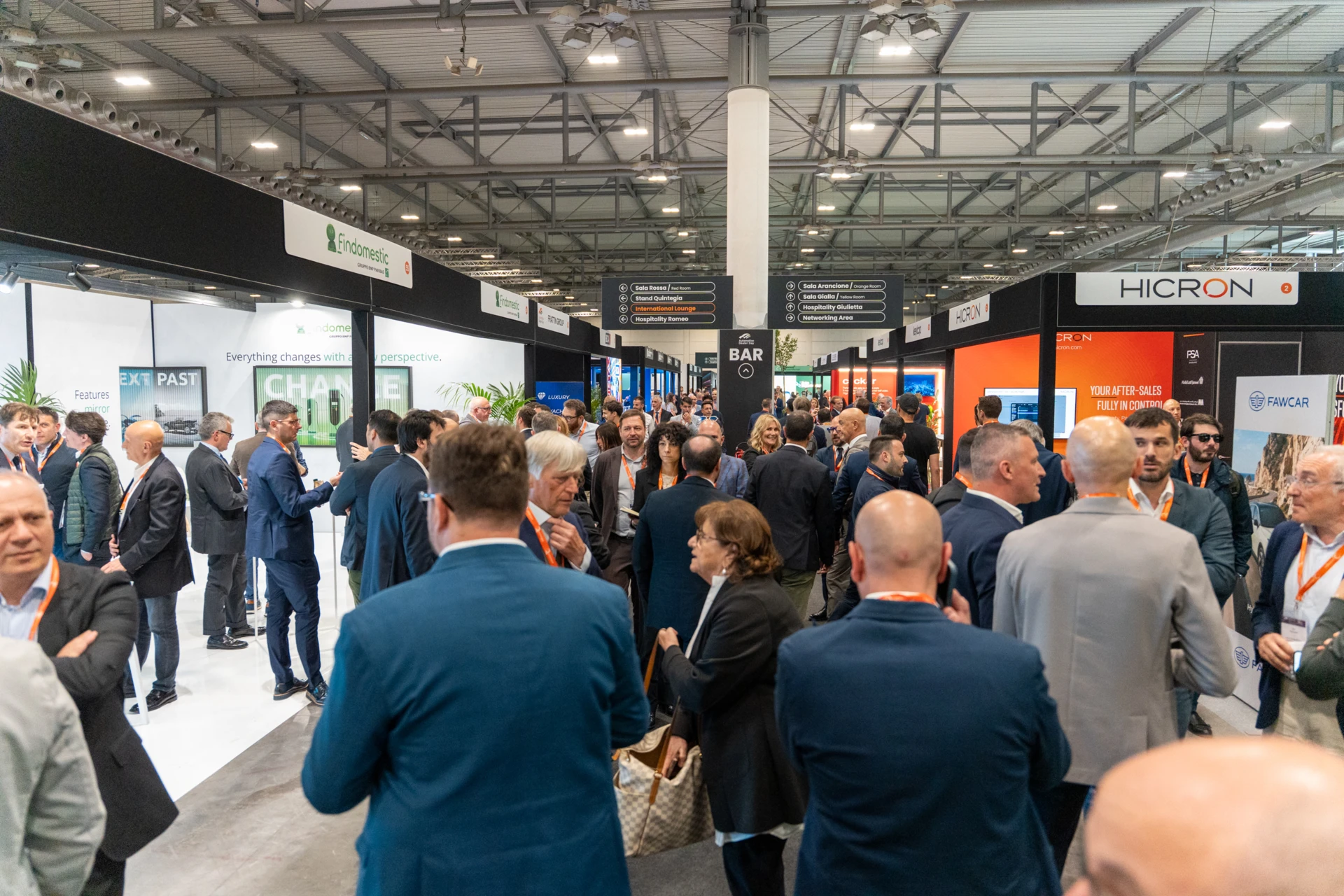
The 24th edition of Automotive Dealer Day – House of Mobility, held in Verona, Italy, sent a clear message to the automotive sector: future success will depend less on the ability to keep up with change and more on the ability to anticipate it.
In an environment marked by electrification, digitization, new distribution models, increasing pressure on margins, and changes in consumer behavior, the industry is facing one of the most profound periods of transformation in its history. In this context, information is no longer merely an operational resource but has become a strategic asset.
The figures from the 2026 edition demonstrate the growing importance of this forum as an international platform for strategic reflection on the automotive industry. The event brought together more than 7,000 participants, marking significant growth compared to the previous edition, and saw a 20% increase in the number of exhibitors, reflecting the dynamism and appeal of the mobility ecosystem.
Over the course of more than 60 working sessions, with the participation of 70 experts and industry leaders, discussions focused on the key challenges related to the transformation of distribution models, the digitization of the customer experience, electrification, and the evolution of business models based on services and mobility.
The international dimension was one of the distinguishing features of this year’s event. In addition to strong European representation, the event drew participants and decision-makers from the United States, Canada, Brazil, and China, highlighting that the challenges facing the industry are increasingly global and interdependent.
This geographic diversity reinforced one of the event’s key conclusions: in a context where geopolitical, economic, and regulatory factors directly influence business decisions, the ability to interpret data, anticipate scenarios, and support decisions through Business Intelligence has become a critical competency for manufacturers, distributors, and mobility operators.
The scale achieved by Automotive Dealer Day 2026 demonstrates that the sector’s future will be built on a combination of strategic vision, international collaboration, and the intelligent use of information to support new business models.
One of the central themes of the event was the growing difficulty brands face in gaining relevance in a market saturated with information, offers, and stimuli. However, capturing the customer’s attention is only the first step. The real challenge lies in transforming that attention into trust, relationships, and sustainable value.
For this to happen, organizations need an integrated view of the business, supported by reliable data and analytical capabilities. This is where Business Intelligence plays a crucial role.
The ability to transform data from sales, marketing, after-sales, digital channels, mobility, and customer experience into “actionable” insights enables decision-makers to understand trends, anticipate behaviors, and identify growth opportunities before the competition does.
Evolutions in the automotive sector are creating business models that are significantly more complex than traditional vehicle sales processes.
Dealership models, subscriptions, connected services, mobility as a service (MaaS), digital ecosystems, and omnichannel experiences require management based on multidimensional metrics and real-time information.
In this new landscape, the strategic questions are no longer just:
But also:
Answering these questions requires robust analytical platforms, predictive models, and a data-driven organizational culture.
Automotive Retail: From Operations Center to Intelligence Center
Automotive Dealer Day also reinforced the idea that automotive retail continues to play a central role in creating value.
However, the dealership of the future will increasingly move away from being a traditional point of sale and toward becoming a center for customer relationships, experiences, and data management.
The most competitive organizations will be those capable of integrating information from multiple sources and transforming it into knowledge to support business, operational, and strategic decisions.
Business Intelligence thus evolves from a reporting tool into an instrument of business leadership.
The presence of experts and representatives from various international markets highlighted another growing challenge: the influence of geopolitical, economic, and regulatory factors on business decisions.
In an increasingly unpredictable global environment, the competitive advantage lies with organizations that can anticipate scenarios, identify risks, and respond quickly to change.
The combination of Business Intelligence and Artificial Intelligence will enable a transition from reactive management to predictive management, creating organizations that are more resilient and better prepared for the future.
The main takeaway from Automotive Dealer Day 2026 is clear: the future of mobility will be led by companies capable of transforming information into knowledge and knowledge into action.
In an industry where business models are evolving at an unprecedented pace, Business Intelligence has emerged as one of the key drivers of transformation. More than just supporting decision-making, it enables organizations to set a strategic direction, identify opportunities, and build sustainable competitive advantages.
In an ever-changing market, data is no longer just a source of information. It is the foundation upon which the entire strategy is built.